
What does the new Building Safety Levy mean for construction companies in 2026?
The Building Safety Levy came into operation in England on 1 October 2026, adding another requirement to an already significantly changed building safety landscape.
We’ve just updated our Building Safety Act 2022 course to include a new overview of the Building Safety Levy, what it means for different organisations involved in a project, and links to official guidance for those who need more detailed information.
But for many people working across construction, the challenge isn't knowing every detail of every new regulation. It's understanding the wider framework, knowing what is relevant to their role and recognising when something has changed.
And that is exactly why Building Safety Act training needs to keep evolving too.
Another change to an already changing framework
The Building Safety Levy is a new tax on certain new residential development in England. It is collected by local authorities, with the money raised contributing towards the cost of addressing building safety defects.
There are detailed requirements covering when the Levy applies, exemptions, calculations and the responsibilities of different parties. Rather than repeat that guidance here, you can find the full and current requirements on GOV.UK.
For us, the introduction of the Levy highlights something bigger.
The building safety framework hasn't stood still.
How well do your teams understand the Building Safety Act?
There is still a lot of confusion around the Building Safety Act and the wider changes that have followed it.
Which requirements apply to all building work? Which are specific to Higher-Risk Buildings? What does being a Principal Contractor actually mean in practice? Where does the Building Safety Regulator fit in? And when new requirements such as the Building Safety Levy are introduced, who needs to know about them?
Not everyone involved in a construction project needs to become a Building Safety Act expert.
But people do need an appropriate level of understanding for their role.
That means understanding the wider framework, recognising their responsibilities and knowing how their actions fit alongside those of clients, designers, contractors, building control and other dutyholders.
Training needs to change when the requirements do
Completing a course once shouldn't mean the subject is considered dealt with forever.
When legislation, regulations and guidance develop, learning content needs to be reviewed too. Sometimes that means a small update. Sometimes it means adding new content or changing an existing example to make sure it still accurately reflects what learners may encounter.
That's why we've reviewed and updated Emblem's Building Safety Act 2022 course for October 2026.
The latest version now includes an accessible overview of the Building Safety Levy, where it sits within the wider framework and what it can mean for the different people and organisations involved in a project.
We're not trying to turn every learner into a building safety specialist. The aim is to give people a strong foundation from which to understand the framework and how it relates to their work.
Can interactive digital learning make the Building Safety Act easier to understand?
We think so.
One of the problems with compliance training is that it's very easy to present learners with page after page of legislation, definitions and responsibilities.
They might complete it. They might even pass the knowledge check.
But do they understand what any of it looks like in practice?
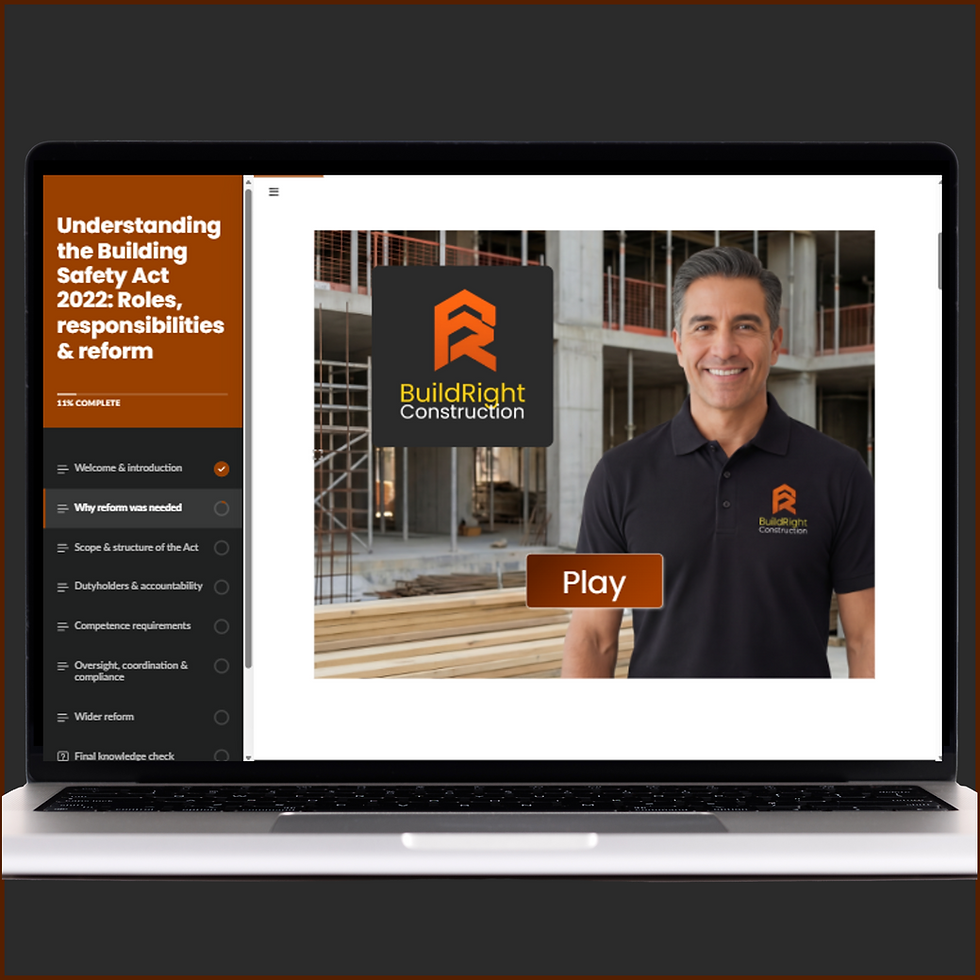
Our Building Safety Act course uses interactive digital learning and scenario-based examples to help learners connect the information with a realistic project.
Throughout the course, learners follow BuildRight, a fictional construction company taking on the role of Principal Contractor on a new residential development.
Instead of only reading about responsibilities, learners see how different requirements can affect BuildRight, the project and the other organisations involved.
It's the difference between simply being told what a requirement says and being able to see “What could this mean for us?”
What if BuildRight isn't anything like your organisation?
Then we can change it! For organisations delivering Building Safety Act training across their own teams, the standard course can be customised and rebranded.
And that goes much further than changing a logo.
If you're a Principal Designer organisation, for example, we can replace the BuildRight scenario with one that reflects the role of a Principal Designer.
If you're a Principal Contractor, developer or another organisation working within the building safety framework, we can develop scenarios around the situations, decisions and responsibilities your people are more likely to encounter.
Your branding, terminology, policies and procedures can also be incorporated where appropriate.
Because scenario-based learning becomes much more powerful when learners can recognise themselves in the situation.
Building Safety Act training updated for October 2026
Our Building Safety Act 2022 course provides an accessible introduction to the Building Safety Act and wider building safety framework for people involved in building projects.
It has been reviewed and updated for October 2026, including new content introducing the Building Safety Levy and its place within the wider regulatory process.
Individual and team licences are available, or organisations can speak to us about creating a customised version of the course with scenarios tailored to their own roles and projects.


Comments